Skip navigation

It’s difficult to point to any one influence that was the seed of my horror interest. There were movies, T.V., music, books, stories, even games like Dungeons and Dragons. Whatever the case, I gravitated to short horror and weird stories as a staple in my reading. The earliest story that sticks in my mind is a story called All Summer in a Day by Ray Bradbury. I read this story in 6th grade as part of a reading program in our school. While I probably read dozens of short stories that year as part of this program, this is the only story that I remember. It is a story about a class of school children who have grown up on Venus where it has rained continuously their entire lives. But one day the scientists predict that the sun will come out. The kids are excited to the extreme because they have never experienced the sun before. But there is one little girl who is unpopular and the children play a prank on the girl by locking her in the closet. The teacher comes in and tells the children that it’s time to hurry up and go outside so they can enjoy the brief time the sun will be out. The children, in their excitement, forget about the girl in the closet and go out to enjoy an hour’s worth of sunshine. When they return to the classroom they remember the girl in the closet. This story, while not really a true horror story, possesses an element of cruelty and sadness that had a lasting effect on me.

My dad had the Complete Works of Edgar Allan Poe and it was this book that was the real cause for me to start writing short horror stories. It wasn’t just Poe’s stories, either. I also became fascinated with his life as well. From Poe I gravitated to Lovecraft and then on to all the staples of the short horror genre. I must mention that I am a voracious bibliophile and my reading interests include: eastern and western philosophy, history, science, martial arts, music, eastern and western religion, poetry, classic literature, fantasy, as well as horror. Well, I used to read short horror rather haphazardly until it got to the point where I couldn’t keep track of whether or not I had read a story. So, about two or three years ago I started re-reading all the short horror in my collection and logging the titles along with a rating of the story. So far I have logged over 1200 stories from every name you can think of (although, I have to say that the majority comprise established authors). From this list my obvious favorites are: Bierce, Blackwood, Poe, Lovecraft, M.R. James, E.F. Benson, F. Marion Crawford, H.G. Wells, Bradbury, Robert Bloch, King, and William Hope Hodgson.

My own writing is directly influenced by the writing of these authors although I do bring my own style and ideas to the genre. For example, just like the majority of King and Lovecraft stories take place in the New England environs they were accustomed to, many of my stories take place in Alabama. One of the things I have “invented” comes from a standard classical music theme – the sonata. The typical sonata has evolved into a three-part composition that has a pattern of: moderately fast – slow – fast. This works great in music and the slow part serves to balance the fast parts on both sides. But a horror story has a different dynamic altogether. A short horror story should steadily build in tension until it ends with a Bang! So I developed the three-part short horror story. Its parts go: mild tension – moderate tension – maximum tension. Here is an example of this device from my story The Sacred Burial Ground. In part one, the mild tension part, the two main characters attend a Native American festival where an old storyteller relates the story of an old burial ground and this triggers one of the characters into remembering their grandfather telling the same story except he told of the burial ground being disturbed and releasing a curse. He thinks he knows where the place is and so the two decide to go and see if they can find it. The second part finds the two guys venturing into the sacred burial ground by the light of day and something happens that frightens them to the point of fleeing the place. After returning to safety they muse what the place must be like at night and agree that it is something they swear will never happen. The third part builds to maximum tension by placing the two back in the burial ground, not just at night, but also in the middle of a thunderstorm (I only outlined the sketchiest of details of this story so as not to spoil the plot). I have used this device in several stories and it seems to be a good formula for both plot development and length of story.

For Christmas my wife got me a three-book set by S.T. Joshi – The Weird Tale, The Modern Weird Tale, and The Evolution of the Weird Tale. I haven’t gotten very far in The Weird Tale but I’ve read enough to spur my thinking about a couple of topics. The first is about the term weird tale to describe a type of short story. I’ve always had a problem with the term. One reason is because of the eponymous magazine where many of the authors who are identified with the genre published their stories. By calling a story a weird tale it automatically makes me think of the magazine. Another reason that I don’t really care for it is because it seems to be such a huge umbrella term. For me, I like short stories that aim to convey horror and think that horror short stories belong in a different category than stories that aim to convey fantastic or strange worlds. For example, Lovecraft wrote many stories that are sometimes referred to as his “dream cycle” stories and I really don’t like them. I think they are very different in style from his horror stories. So as I’m reading about Lord Dunsany I’m wondering if his being classified as a weird tale writer makes him a writer of horror or a writer of fantasy. I get the impression that his aim was for fantasy and not horror. But the usage of weird tale has been co-opted to be synonymous with short horror story. At least I believe that to be the case.

The other thing that got me thinking was that Joshi says that by understanding an authors philosophy, you can understand their writing. This may be true for some but not for all. When I write a short horror story I’m not trying to make a philosophical statement. I’m a pantheist who detests religion and believes that there is no God or Satan as depicted in Western Religion. But I use the archetypes to portray a battle of Good vs. Evil in my stories. I don’t believe in ghosts but I’ll write ghost stories. I suppose that if I were to try and express my philosophy in a horror story it would be similar to Lovecraft’s portrayal of a world where humans encounter alien forces that either perceive them as minor beings (as we would a bug) or they don’t even perceive them at all. Except where Lovecraft was atheist, I would try and show that there is no true good or evil from the global perspective. God – or the Universe – evolves as it wills without any concern for kindness or compassion to the tiny beings that are spawned within.

Then I started thinking that if someone were to try and psychoanalyze me based on my horror stories, what sort of themes run through them? This is very telling in way I never noticed till I did this. There are two main themes that I explore in my stories: possession and curse. Virtually every one of my stories involves some type of curse or some sort of possession by malevolent force. I’ll refrain for now from delving too deep into the meaning of these two themes.

When I was a kid I loved to watch The Twilight Zone. That show had a huge influence on how much importance I place on the endings to my stories. The best part of TTZ was the twist-ending. While Rod Serling didn’t invent the twist-ending, he sure did make it a trademark for The Twilight Zone.

It is my opinion that a short horror story or weird tale is not complete unless it has a twist-ending. This may fly in the face of many horror or weird writers but I don’t care. The twist-ending is such a strong element that a story falls flat unless the reader is left with a bang at the end. Plus it has the added benefit of leaving a far stronger lasting impression on the reader than an ending that is nothing more than the end of the narration. Hell, a great twist-ending can turn a mediocre story into a good story simply because it is the last impression the reader is left with.

But how do you define what exactly a twist-ending is? I think that a twist-ending is when the author reveals to the reader (or viewer in the case of film) the answers to the holes in the plot in such a way that it shocks the reader (viewer). There are three basic ways this is done: 1) the author reveals to the reader a key piece of the plot that answers any ambiguities that have been left unanswered, 2) the reader has been led to conclude one direction in the plot and the author reveals something that totally turns that assumption on its head, and 3) a shock is revealed that makes the plot have a far greater ramification than the reader suspected.

I place a great deal of importance on the endings to my stories in the hopes that I achieve a twist that leaves the reader going away from the story with more to think about than just the events of the story.

Inevitably, when people find out just how deep my interest in reading and writing short horror stories goes, they ask, “Why are you so interested in short horror stories?”

The underlying message usually being that it is 1) a bit abnormal to be so fascinated with something that has a stigma of the darker side of human nature, and 2) that short horror stories are an inferior and baser form than, say, horror movies and horror novels.

Of course, I would like to explain and hopefully dispel these misconceptions a bit.  More importantly, I would hope to expand the reader’s understanding of the many intriguing facets of the art of crafting a truly good short horror story.  Call it “Short Horror Appreciation 101”.  Who knows, maybe the reader will even look at short horror stories in a new light and appreciate them the way I do.

I must first address the issue of the sinister, dark, ugly, and evil side of our world and just why it is that the subject matter of so much horror stories explores this taboo region of our reality.  For the dark is, in the end, a natural part of our reality no matter our level of disdain or fascination.

In philosophy and religion the debate rages on concerning the fundamental nature of good and evil and how they influence our morals and lives.  The view that good and evil exists as independent forces outside of any sentient, intelligent being is the foundation of many beliefs and belief systems.  It provides the backbone of religion and the existence of the moral law.  However, the arguments against such an independent existence of these forces are much stronger and closer to what science has revealed about the inner workings of nature.

My personal belief is that good and evil are largely creations of the relationships of individuals and societies and rests in the nature of intelligent beings struggling to understand their place in the cosmos.  No person is wholly good or wholly evil.  Every person possesses the capacity of both within their nature just as the cosmos possesses the potential of both to arise within itself.  We are mirrors of the cosmos and express the same processes on a more microscopic level.

Therefore, it is completely natural for humans to explore their nature and since the dark nature is a part of that, it follows that humans will always be compelled to explore their darker nature just as they shall always explore the good.  This is evident everywhere in society and expresses itself on many levels across a broad spectrum.  Our curiosity is bent in this direction through the media, our entertainment, in businesses, in sports, in our religions, and on and on.  After all, most great stories are incomplete without the tension created by the villain.

Many religious people warn that such explorations lead, inexorably, to a possession by evil forces.  While they are entitled to their beliefs, I find these beliefs childish and ignorant.  Arguments as to how I can prove this would entail a whole other essay.  Let me just say that I don’t believe in Heaven, Hell, Satan, the God of the Bible, angels, demons, or any such similar fanciful mythologies.

I do believe that there are dangers in being wholly obsessed with just evil and leading or justifying a decadent and immoral life.  But reading and writing short horror stories is just an outlet for the expression of the darker side of our nature.  It is the same as listening to music, watching movies, or playing video games where you temporarily escape into a fantasy realm.

If these things really caused people to be evil then we would expect to see everyone who played Doom to be gun wielding maniacs, everyone who had read Misery to be crazed torturers, and everyone who listened to Black Sabbath to be swelling the ranks of Satanic churches across the globe.  These things may be influences on people bent on doing evil but they are definitely not causes of evil.  Conversely, if exposure to goodness and religion were guarantees of a person being good then we wouldn’t see priests raping young boys or evangelists lying about their sexual deviance.

As to the view that short horror stories are a lesser art form than other styles of writing or other forms of horror, I hold the opinion that it is a very unique art form when executed well.  Unfortunately, in the current marketplace, it is neither popular nor frequently executed well.

Most authors feel and succumb to the pressure to write novel length works in order to gain attention.  There just isn’t a market for anthologies of short horror stories by individual authors, so the publishers push authors to write novels.

This is fine but another problem has arisen in the pulp style, trade magazines because of this.  It used to be that magazines were the place that featured short stories as the ends and means of themselves.  But now, the magazines are just a place to prostitute the author trying to sell their novel.  The authors generally churn out a sub-par short story so they can market their novel in the introductory blurb to the story.

Judged on the merits of the short story alone, they fall far short of the benchmark set by such luminaries as Poe, Lovecraft, Bierce, Blackwood, and James.  Oft times the most horrible thing about their story is the plot.

Horror’s goal is to elicit feelings of fear in the reader.  Fear is a very powerful emotion that causes very tangible physiological and psychological reactions.  It is this goal that must be in the forefront of the author’s mind as he or she writes.

Of course, there are many tools at the author’s disposal with which to accomplish this task:  atmosphere, plot, language, word usage, imagery, tempo, situation, character development, the list goes on and on.

What makes the short horror story unique, however, is that it is a perfect vehicle for tension that rises and rises until the end of the story – whether or not the end releases the tension or only serves to leave the tension unresolved.  Usually, the story can be read at one or two sittings whereas a novel has a tougher time sustaining this type of continually rising tension (although there are some exceptions).

A novel is generally better suited for character development because there is more space and time to create a bond with the character.  Horror movies share the shortness of the short horror story and have an added benefit of direct imagery.  Some think this to be better but it isn’t always the case.  Many readers have quite inventive imaginations and their interpretations are varied and more terrifying than a movie might portray.

The area where a short horror story is better than a movie is in the psychological realm.  Movies just can’t relay the thoughts in a character’s head as well as a first or third person narrator.  A movie draws the viewer’s attention primarily to visual things and reading draws the reader’s attention to primarily whatever the author deems necessary at the time to making the story successful.

All of my preaching from atop my soapbox is fine and good but the real proof is in the pudding.  After quite extensive reading of hundreds and hundreds of short horror stories I can point to a whole slew of stories where the author fully grasped the keys to creating a truly successful short horror story that can stand alone as a true work of art that both explores the dark side of our nature and creates a very real sense of fear in the reader.


I dearly wish that I didn’t have to work a full time job and that I could spend my days both reading and writing. But, alas, I must dedicate a mere smidgen of my time to reading short horror/weird tales and writing. I also enjoy reading and writing in other areas of interest so even my part time dedication to weird tales is part time. I envy that Lovecraft had free time to be so well-read in the genre and be able to pen his seminal essay Supernatural Horror in Literature. He finished that work in 1935 and I would love to be able to bring the genre up to date myself but this is truly a dream I don’t see coming to fruition. Another element of difficulty is that since then there has grown a legion of descent writers that would need to be mentioned making my task even more surmountable.

I can offer a different approach, however. I am still pretty well-read in the genre and have discussed in this blog my practice of logging the stories I read and ranking them. Currently, as of today, I have read over a thousand stories in the genre. From this list I have assembled the best of the best and that list numbers over a hundred stellar stories that are must reads. Many of these stories Lovecraft makes mention of either the story itself or, at least, the author. To this I can add several authors that I would say have added numerous stories to the genre; authors such as Ramsey Campbell, Ray Bradbury, Richard Matheson, Robert Bloch, Robert E. Howard, Stephen King, Manly Wade Wellman, and most definitely, the author who penned Supernatural Horror in Literature himself, H.P. Lovecraft.

I will make it abundantly clear that I recognize I have missed many good authors and that is simply because I have yet to read their work. I have several stacks of books yet to be read. I just haven’t gotten around to reading them yet. I can’t very well comment on gaps in my reading in the genre.

Recently I purchased the book H.P. Lovecraft’s Favorite Weird Tales which includes two lists that Lovecraft recommended to be read in the genre. The second list was an updated list based on the fact that Lovecraft had read some additional stories. These were, supposedly, Lovecraft’s favorite weird tales. Of the 18 stories included in the book I have read 10 already.

Narrowing down a list to the top 10 seems like a task I care not undertake. What I would like to do now is comment on specific stories and their authors which I believe should be must reads in the genre but may not be the most commonly mentioned or readily accessible stories. The following list from my Listmania list on Amazon is a resource on where to find nearly all of the stories I will mention. Keep in mind that this is a mere smattering of the hundred or so stories that I currently list as must reads – the rest being many stories by the authors Lovecraft mentions in Supernatural Horror in Literature and the authors I mentioned above. Also, unlike Lovecraft, I will not spoil any of the plots. I will let the reader discover for themselves why these stories are some of the best weird tales ever written.

http://www.amazon.com/gp/richpub/listmania/fullview/RC22MSOYPL8OZ/ref=cm_rna_own_lm/103-5607512-2401439

The first story is Moonlight Sonata by Alexander Woollcott (1887-1943). Woollcott was a writer for The New Yorker who seems to have written nothing else in the genre. A curious fact about him is that he died on live radio. The story is very short but powerful in its conclusion. Much of the effectiveness in this story is in the fact that Wooollcott left much unsaid that a creative mind is able to speculate on.

The next story is The Thing in the Cellar by Dr. David Henry Keller (1880-1966). Dr. Keller was a physician who dabbled in weird tale writing on the side. This story first saw publication in Weird Tales in 1932.

Orange is for Anguish, Blue for Insanity is a pleasantly disturbing tale by David Morrell (b. 1943). Morrell is a Canadian born author best known for creating the character Rambo in his novel First Blood. This particular story ranks right up there with The Wendigo (which I think is slightly better than The Willows) in its otherworldly weirdness.

Moving on, we come to The Ghost of the Capuchins by Eugene Montfort (1877-1929). Montfort was a French novelist who wrote mostly in a Mediterranean setting. This story is cleverly plotted and well worth the read.

The Entrance is an instant classic by Gerald Durrell (1925-1995). Durrell was an Indian born Brit best known for his naturalist work and bio-environmental conservation efforts. For whatever reason he wrote this horror story and I, for one, am thankful he did. There are many different elements that make this story a gem.

My next pick is a story called Keys and Locks and Open Doors by Jane Wallis Hicks. I haven’t been able to find an ounce of information on Hicks. This story appeared on a now defunct website and gives no details about her. The story itself is written in an archaic, Quaker, New England settler style of language that is a perfect vehicle for delivering this unsettling tale.

The next story is another Weird Tales alumnus called Canavan’s Back Yard by Joseph Payne Brennan (1918-1990). Brennan wrote many novels and short stories. Many of his short stories appeared in Weird Tales in the early fifties. I haven’t had the opportunity to read any of his other work but one day I’ll get around to reading one of his short story collections.

The Beckoning Fair One by the Brit author Oliver Onions (1873-1961) is a story that I am surprised Lovecraft failed to mention in Supernatural Horror in Literature. This story has many features that mark it as a classic horror tale. The ending is a real masterpiece that leaves you thinking about the story for a while. Onions was a commercial artist turned author. I’m not sure he ever produced any other horror of this caliber, though.

Another story that deserves to be ranked among the classics and I was surprised Lovecraft failed to mention in Supernatural Horror in Literature is How Love Came to Professor Guildea by Robert Hichens (1864-1950). Hichens was a Brit who wrote several novels but seems to have only written a couple of short stories. This particular story is a masterfully written haunting with an unusual twist.

Ray Bradbury (b. 1920) has written many weird tales that will ensure he is ranked among the best weird tale writers. I could list any number of his stories as being must reads but there is one story in particular that I feel is his best weird tale. The story entitled The Jar is a very unusual story that Bradbury has done a wonderful job in weaving a really weird tale with. Bradbury is a goliath in the science fiction genre best known for The Martian Chronicles and Fahrenheit 451.

He Wanted to Live by Richard Matheson (b. 1926) is a perfectly crafted horror tale. Matheson is another author who has written many great short stories that are must reads. Matheson is best known for his work on the T.V. series The Twilight Zone (the episode entitled Nightmare at 20,000 Feet is most popular) and his novels that have become major motion pictures (Stir of Echoes and What Dreams May Come). Read this story and you’ll see why I chose it!

While I haven’t read more than a handful of stories by Robert Bloch (1917-1994), I have yet to read one that is not a top-notch story ranking him among the best. Most of the stories I have read by Bloch are Lovecraftian pastiches; however, there is one story called The Rubber Room that deserves to be read by anyone looking for the crème de la crème of weird tales. Bloch is best known as the creator of Psycho. I will definitely be purchasing a collection of Bloch’s short stories in the near future.

It is a shame that Lovecraft couldn’t have lived longer to enjoy the blossoming of the genre and be able to read so many of the great authors who came along in his wake.

Let’s talk about what makes a good short horror story. Whether you want to write them or read them, this introduction should make you mindful of the key elements that make for a really well crafted short horror tale.

Of course, before I ever began writing short horror, I read a great many of them. All the greats and all the not-so-greats. And I began to notice certain elements that worked really well, as well as those that make a story flop.

The first element that makes a good short horror story really work is not provided by the author at all. It’s provided by the reader and it is what brings the eerie magic of a finely crafted short story to its full effect. It is imagination. I am not talking about a simple suspension of belief either. I am referring to the ability to put yourself into the story. It takes a very strong imagination to experience the story through the eyes of the protagonist(s). I have, on numerous occasions, known of people reading a story that I thought was magnificent and they only found it so-so. Confused by this, I wondered how this could be. Typically, I have traced the problem to be a lack of imagination on their part.

One thing the reader can do to foster the right atmosphere and help fuel their imagination is to choose the appropriate time and place for reading the story. This isn’t necessary but the difference is amazing. Let’s face it, a story read in bed, alone, at night, while a rainstorm rattles the windows has a far different effect than the same story read while seated on a bench in the park, during broad daylight, while children are running around laughing and playing.

Now let’s talk about the elements that are under the control of the author. First and foremost the story has to have a good plot. The author doesn’t have to have every detail of the plot worked out in order to begin writing, but the meat of the plot needs to be worked out prior to beginning.

Ideas for plots can come from almost anywhere. The author needs to be careful that their plot is original. There are a couple of ways to ensure that your plot hasn’t already been used. One is to tell your idea to someone else. You’d be surprised at the “that reminds me of blah blah blah” and the “sounds like blah blah blah” that will be given as feedback. If you have a really good critic then they will help you make your plot even better. The second method of verifying you’re not using another author’s idea is to read – a lot!

Many of the plots to my stories are set in my home town of Birmingham, Alabama. The reason is because I am familiar with the area and I want the descriptions of the settings to be convincing. This is not necessary, but I like to do it. The actual plot ideas come from many different sources. Many of them are based on real events that I embellish quite a bit. Others are born out “what if” scenarios that I come up with. And still others are truly scary situations that I have experienced or dreamed up. I figure that if it would scare me, then it would probably scare other people. Wherever the ideas come from, the thing to remember is that the plot had better contain tension, horror, and keep the reader in suspense.

The next element that is of key importance is atmosphere. The author has got to create the appropriate atmosphere as the story unfolds. Within the genre of short horror there are typical atmospheric motifs that are used frequently. The list of these is quite large, but some examples are: the unnamed horror, subservience to overwhelming powers, growing insanity, building hatred, fear of some supernatural force, helplessness in the face of fear, etc. No matter what type of atmosphere the author is trying to create and maintain, it will usually require a sense of escalating tension. That is what the short horror story is a perfect medium for. It is very difficult to maintain rising tension if the story is too long. It is not impossible, but it is usually easier to accomplish over a short span of pages.

Of course, when it comes down to it, word choice is the crucial method to achieving the appropriate atmosphere. This is the real art of writing and can’t be taught through some formula or shortcut. And that’s as it should be. The reason is because this is where the author’s individual style comes through. True creativity in writing is in the author’s choice of words to create an atmosphere in describing his or her plot. As a matter of fact, there are many plots that are similar but their difference lies in atmosphere and word choice.

Earlier I mentioned the length of the short horror story as being conducive to escalating tension. This brings us to the next element and a common question. How long should a short horror story be? The answer is that there is no rule. I have read some great stories no more than a couple of pages as well as great stories that in are jeopardy of being too long to be categorized as a short horror story. But, as a general rule of thumb, I believe that the author should shoot for a story that can be read in less than an hour.

Next, let’s talk about the opening of the story. It is a wise thing to use the first sentence or two to capture the reader’s attention. There are many ways to achieve this. The author can start the story in the middle of the story if he or she so chooses. Starting a story at a gripping part of the tale and then backfilling the reader on the events leading up to where the story first began is a good device to use. The author can also throw in a few hints about where the story will lead without giving the whole tale away. There are many ways to entice the reader, but if the opening of the story doesn’t capture the reader then there is always the chance that the reader will not even bother to read past the opening paragraph.

We should also consider the point of view from which the story is told. I like to incorporate various points of views in my stories. I feel like this keeps the story interesting. Including a found manuscript or a newspaper article are just a couple of ways to include a different point of view in a story. An author should also explore first person perspective and third person perspective to vary his or her stories. And finally, dialogue really brings a story to life. Dialogue is intimidating to many would-be authors. It is really not so difficult to write good dialogue as long as it reads like it is spoken. An author must write like people talk. People say things like “gotta” instead of “got to” and “goin’” instead of “going”. If a character has an accent then the author should strive to capture the accent in the dialogue. This will make the character more believable and bring them to life.

The final element I would like to discuss is a critically necessary element. If it is not present then the story is incomplete. Not only is the story incomplete, but it also flops miserably. I am referring to the twist at the end of the story. Where this tradition began is unknown but it is so necessary to master this element that if it is not done, a great story can be turned into a disappointment.

The thing to remember with the ending is that it must be delivered effectively. It can’t be hokey, either. The ending should leave the reader thinking about the ramifications and meaning of what they have just read. You want the ending to be a surprise to the reader. You also want the reader to walk away from the story feeling satisfied that they have read a great story.

Many times the author gives hints to how the story will end and this may result in the reader seeing the ending coming a mile away. The author must be very careful about giving the ending away too soon. It is O.K. to give hints that will lead the reader to the obvious conclusion as to the ending and then create a different ending that has a bigger twist and is an even bigger surprise. Whatever the case, the ending must be approached much like a good punch line to a joke. The better the punch line the better the joke and the better the twist at the ending of a short horror story the better the story will be. The ending must be the best part of the entire story.

Many of these elements are very obvious things. But I have been quite surprised in my readings at how frequently these standard items are poorly created or are left completely absent even by great authors. That is one of the reasons that I began a log of all the short horror stories I read. I incorporated a rating system of one to five stars depending on how much I like the story. I also write a brief synopsis of what I think about the story. Currently, I have read well over three hundred stories by various authors of various time periods. It was through this exercise that I recognized the key elements that are required to create a good short horror story.

The only podcast that I have followed through each episode and anxiously await each new installment is The H.P. Lovecraft Literary Podcast at hppodcraft.com. The hosts are Chad Fifer and Chris Lackey who are very entertaining as they cover each Lovecraft story. I can’t say enough about their show. It’s very well done, insightful, witty, and a must for any Lovecraft fan!

20110821-144424.jpg

My first brush with short horror/weird tales was in elementary school. We had this mandatory reading program that built up longer and more complex readings of short pieces of material. Of all the things I read in those years of doing that program, only one story got lodged in my brain. It was a strange little tale by Ray Bradbury called “All Summer in a Day”. Not really a horror story exactly, but it was the first real story I can point to as my fascination with weird tales and, ultimately, my own horror story writing. From there I discovered Poe and Lovecraft on to all the short horror authors I admired in my youth and still to this day – people like Ambrose Bierce, M.R. James, Algernon Blackwood, etc. etc. As I began to craft my own stories I naturally got to a point where I thought that seeking publication would be the next logical step. But what I found was that the world at large no longer had much of a place for short horror stories in the vein of these great authors from years gone by. Horror styles and tastes have changed. People want writing that is streamlined and active, action-packed and ultra-modern. People also like novels instead of anthologies or collections. Even the magazines that say they are publishing short fiction are really just places for authors to pimp their novels. The quality of the work is sadly lacking in comparison to the great works of the past. It’s sad to see that half-baked horror is getting published where once used to be the work of the golden age of short horror.

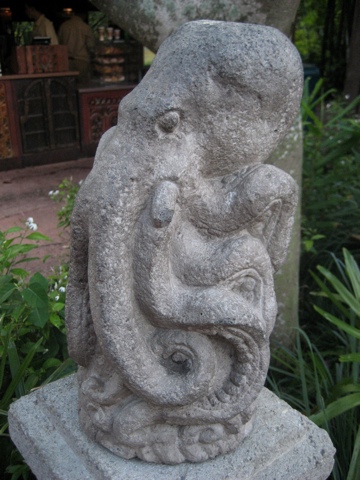
This statue is located at Disney World’s Animal Kingdom. It is in the Asia area close to Mt. Everest. It struck me as odd because it’s very Cthulhu looking.

20110528-105941.jpg

Welcome to my website of horror short stories and horror art.